

 English
 Deutsch
 italiano
 中文简体
中文简体
Author: Admin Date: 2026-02-24
Brushless DC Motor Guide: How They Work and Key Applications
Content
- 1 What a Brushless DC Motor Is and How It Differs from Brushed Motors
- 2 How Brushless DC Motors Work: Principles of Electronic Commutation
- 3 Types of Brushless DC Motors and Their Structural Configurations
- 4 Key Performance Parameters and How to Interpret Them
- 5 BLDC Motor Control Methods: From Simple to Precision
- 6 Industrial and Commercial Applications of Brushless DC Motors
- 7 How to Select a Brushless DC Motor for Your Application
What a Brushless DC Motor Is and How It Differs from Brushed Motors
A brushless DC motor (BLDC motor) is an electrically commutated synchronous motor that uses permanent magnets on the rotor and electronically controlled windings on the stator to produce continuous rotational motion. Unlike brushed DC motors—which rely on physical carbon brushes sliding against a rotating commutator ring to switch current direction in the rotor windings—a brushless DC motor eliminates this mechanical contact entirely. Commutation, the process of switching current through the stator windings in the correct sequence to sustain rotation, is performed by an external electronic controller that uses rotor position feedback to time each switching event precisely. The result is a motor with no wearing contact surfaces between stationary and rotating parts, which is the foundational advantage that defines the brushless DC motor's superior performance profile compared to its brushed predecessor.
This architectural difference has profound practical consequences. Without brushes, there is no brush wear, no carbon dust contamination, no spark generation at the commutation point, and no progressive resistance increase as brush contact degrades. The heat generated in a brushed motor at the brush-commutator interface is absent in a BLDC motor, allowing the motor to operate at higher continuous power densities without thermal damage. The windings are on the stator—the stationary outer housing—rather than the rotating element, which makes heat dissipation to the environment far more efficient. These characteristics collectively explain why brushless DC motors have displaced brushed motors across virtually every high-performance and precision application in modern engineering.
How Brushless DC Motors Work: Principles of Electronic Commutation
The operating principle of a BLDC motor depends on the interaction between a rotating magnetic field generated by the stator windings and the permanent magnets mounted on or embedded in the rotor. The stator typically contains three sets of windings arranged at 120-degree intervals around the stator bore, connected in either a star (Y) or delta (Δ) configuration. The electronic controller applies voltage to these windings in a specific sequence, energizing two of the three phases at a time in six-step commutation, creating a magnetic field that the rotor's permanent magnets align with. As the rotor approaches alignment, the controller advances the energized winding pair to the next step, keeping the magnetic field always ahead of the rotor position and sustaining continuous torque production.
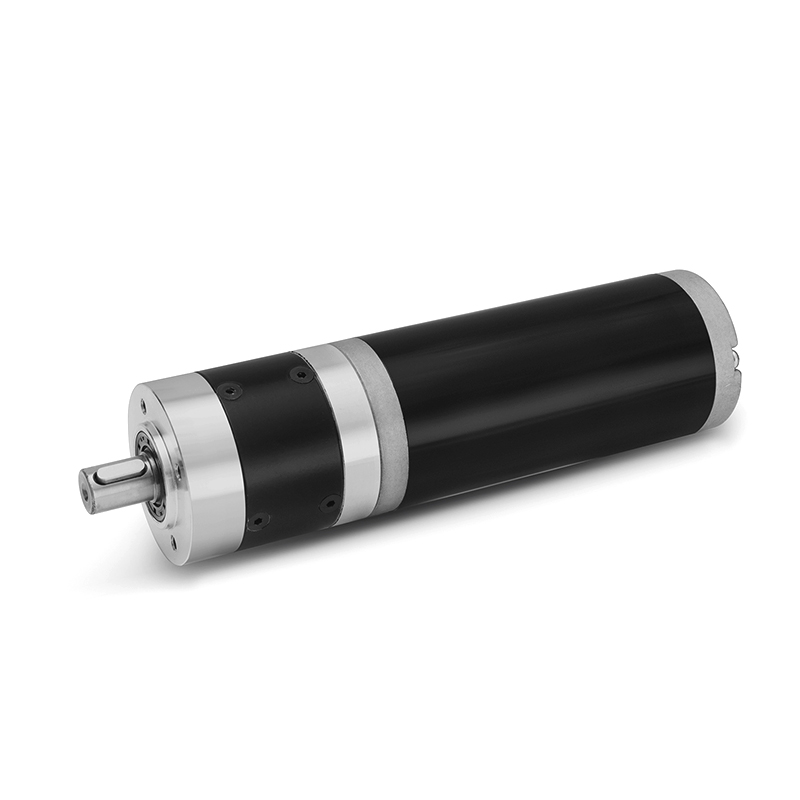
The critical requirement for this process is accurate knowledge of rotor position at all times. In sensor-based BLDC systems, three Hall effect sensors mounted on the stator at 60-degree or 120-degree intervals detect the magnetic field of the passing rotor magnets and send digital position signals to the controller. These signals tell the controller exactly when to advance to the next commutation step. In sensorless BLDC systems, the controller monitors the back-electromotive force (back-EMF) generated in the unenergized winding phase—a voltage induced by the rotating rotor magnets that is proportional to rotor speed and position—and uses this signal to determine commutation timing without physical sensors. Sensorless operation simplifies motor construction and reduces cost but is less reliable at very low speeds where back-EMF signals are too weak to detect accurately, which is why many precision applications retain Hall effect sensors for full-speed-range position feedback.
Types of Brushless DC Motors and Their Structural Configurations
Brushless DC motors are produced in several structural configurations, each optimized for specific performance characteristics and application requirements. Understanding the differences between these configurations is essential for selecting the right motor for a given engineering challenge.
Inrunner (Inner Rotor) Configuration
In the inrunner configuration, the permanent magnet rotor rotates inside the stator winding assembly—the conventional arrangement shared with most other electric motor types. Inrunner BLDC motors have a smaller rotor diameter, which results in lower rotational inertia and the ability to accelerate and decelerate rapidly. This makes them well-suited to applications requiring fast dynamic response, such as servo drives, robotic joints, and CNC machine spindles. Their higher speed capability—often reaching 50,000 to 100,000 RPM in small high-performance versions—combined with compact external dimensions makes inrunner motors the preferred choice where speed and dynamic performance take priority over peak torque at low RPM.
Outrunner (Outer Rotor) Configuration
The outrunner configuration inverts this arrangement: the permanent magnet assembly forms the outer shell of the motor and rotates around the fixed inner stator. Because the rotor has a larger diameter, it generates higher torque at lower speeds than an inrunner of equivalent volume—a characteristic described by the longer moment arm at which the magnetic forces act. Outrunner BLDC motors are widely used in drone propulsion, electric bicycle hub drives, and direct-drive cooling fans, where high torque at moderate rotational speeds eliminates or reduces the need for gearboxes. The rotating outer shell also provides more surface area for heat dissipation in air-cooled applications, which is an additional advantage in continuous-duty motor applications.
Axial Flux Configuration
Axial flux BLDC motors orient the magnetic flux path along the motor's rotational axis rather than radially, producing a disc-shaped motor with a very short axial length relative to its diameter. This geometry yields exceptionally high torque density—more torque per kilogram of motor mass than conventional radial flux designs—and is increasingly used in electric vehicle traction motors, wind turbine generators, and aerospace actuators where the power-to-weight ratio is a critical design constraint. Axial flux motors are more complex to manufacture than radial designs but represent the direction in which premium-performance BLDC motor technology is advancing most rapidly.
Key Performance Parameters and How to Interpret Them
Selecting the correct brushless DC motor for an application requires understanding the motor's published specification parameters and what they mean in practical operating conditions. The following table summarizes the most critical BLDC motor specifications and their significance:
| Parameter | Unit | What It Tells You |
| KV Rating | RPM/V | No-load speed per volt of applied voltage; higher KV = faster, lower torque per amp |
| Continuous Current Rating | Amperes (A) | Maximum sustained current without thermal damage to windings |
| Peak Current Rating | Amperes (A) | Maximum short-duration current; typically 2–3× continuous rating |
| Stall Torque | N·m | Maximum torque at zero speed; defines the motor's peak force capability |
| Motor Resistance (Rm) | Ohms (Ω) | Winding resistance; lower values = less copper loss and better efficiency |
| No-Load Current (I₀) | Amperes (A) | Current consumed with no mechanical load; represents friction and iron losses |
| Efficiency | % | Ratio of mechanical output power to electrical input power at rated load |
| Pole Count | Number of poles | More poles = smoother torque at low speed, lower top speed for given KV |
The KV rating deserves particular attention because it is often misunderstood. A motor rated at 1,000 KV will spin at approximately 1,000 RPM per volt applied with no load—so at 12V supply it would reach approximately 12,000 RPM unloaded. Under load, actual speed will be lower due to voltage drop across winding resistance. Low-KV motors (100–500 KV) are designed for high-torque, low-speed applications and are wound with more turns of thinner wire, while high-KV motors (2,000–10,000 KV) are wound with fewer turns of thicker wire for high-speed, lower-torque applications. Matching KV to the supply voltage and required operating speed range is the first sizing step in motor selection.
BLDC Motor Control Methods: From Simple to Precision
The electronic controller—variously called an ESC (electronic speed controller) in hobby and drone applications, or a motor drive or inverter in industrial contexts—is as important as the motor itself in determining system performance. The sophistication of the control method determines how precisely speed, torque, and position can be regulated and how efficiently the motor operates across its operating range.
Six-Step (Trapezoidal) Commutation
Six-step commutation is the simplest and most common control method for BLDC motors, applying DC voltage to two of the three stator phases at a time in a repeating six-step sequence synchronized to rotor position via Hall sensors or back-EMF detection. Each commutation step covers 60 electrical degrees of rotor rotation, producing a trapezoidal current waveform in each phase. Six-step commutation is straightforward to implement, computationally inexpensive, and adequate for many variable-speed applications. Its limitation is that the abrupt switching between commutation steps produces torque ripple—a periodic variation in output torque that manifests as vibration and audible noise, particularly at low speeds. For applications where smooth rotation is critical, more sophisticated control methods are required.
Sinusoidal Commutation and Field-Oriented Control (FOC)
Sinusoidal commutation applies smoothly varying sinusoidal currents to all three stator phases simultaneously, producing a smoothly rotating magnetic field that minimizes torque ripple dramatically compared to six-step control. Field-oriented control (FOC), also called vector control, extends this further by mathematically decomposing the stator current into two orthogonal components—one that produces torque and one that controls the magnetic flux—and controlling each independently in real time using high-speed digital signal processors. FOC achieves the lowest possible torque ripple, highest efficiency across the full speed and load range, and the fastest dynamic response of any BLDC control method. It requires accurate rotor position feedback—typically from an encoder or resolver rather than Hall sensors—and significant computational resources, but is the preferred control method for servo drives, electric vehicle traction systems, and any application where smooth, precise motion control is non-negotiable.
Industrial and Commercial Applications of Brushless DC Motors
Brushless DC motors have penetrated virtually every sector of modern engineering where rotary motion is required, replacing brushed motors, AC induction motors, and hydraulic drives in applications ranging from sub-gram micro-motors to megawatt-class traction drives. Their specific combination of high efficiency, long service life, compact size, and precise controllability makes them the motor technology of choice across the following major application areas:
- Electric vehicles and e-mobility: BLDC motors power traction drives in electric cars, electric motorcycles, electric bicycles, and electric scooters. Their high power density—typically 1–5 kW/kg for automotive-grade motors—combined with efficiency exceeding 95% at optimal operating points makes them the only practical choice for battery-powered vehicle propulsion where energy management is critical to range.
- Drones and unmanned aerial vehicles (UAVs): Multi-rotor drone propulsion is almost universally provided by outrunner BLDC motors paired with electronic speed controllers. The motors must deliver high thrust-to-weight ratios, respond to speed commands within milliseconds for flight stabilization, and operate reliably through thousands of flight cycles—requirements that only brushless technology satisfies at the power levels involved.
- Industrial automation and robotics: Servo BLDC motors with FOC control and high-resolution encoders drive robot joint actuators, CNC machine axes, semiconductor wafer handling equipment, and precision positioning stages. The combination of zero-backlash direct drive, sub-micron position resolution, and rapid dynamic response enables automation systems to achieve productivity and precision levels impossible with any other drive technology.
- HVAC and appliance motors: Variable-speed BLDC motors have replaced fixed-speed AC induction motors in high-efficiency refrigerator compressors, inverter air conditioners, and premium washing machines. Operating the compressor or fan at exactly the speed required by the thermal load—rather than cycling on and off at full speed—reduces energy consumption by 30–50% compared to single-speed systems, which has driven regulatory-mandated adoption of brushless technology in appliance markets globally.
- Medical devices: Surgical tools, dental handpieces, infusion pumps, and powered prosthetic limbs use miniature BLDC motors for their combination of high power density, precise speed and torque control, long maintenance-free life, and compatibility with sterilization environments. The absence of brush dust is particularly critical in medical applications where contamination of any kind is unacceptable.
- Computer and data center cooling: Server cooling fans, hard disk drive spindle motors, and optical disc drive motors use miniature BLDC motors operating continuously at precisely controlled speeds. The hard disk drive application in particular demands extreme precision—spindle motors must maintain speed within 0.01% across millions of operating hours—which only brushless electronic commutation can achieve.
How to Select a Brushless DC Motor for Your Application
Selecting the correct BLDC motor requires working through a structured set of application requirements before consulting motor catalogs or supplier datasheets. Jumping directly to motor selection without establishing clear requirements leads to either underspecified motors that fail prematurely or overspecified motors that waste budget and space. The following process covers the essential steps:
- Define the mechanical load: Establish the required output torque at the shaft, the operating speed range, and whether the load is constant or cyclically varying. For rotary loads, calculate the required torque from first principles—force times moment arm for linear loads converted through a screw or pulley, or load inertia times required angular acceleration for dynamic positioning applications. Add a service factor of 1.25 to 1.5 to the calculated requirement to account for real-world variations.
- Establish the supply voltage and power budget: The available DC bus voltage determines the practical KV range and the maximum no-load speed achievable. For battery-powered applications, consider voltage sag under load and the motor's performance at minimum battery state of charge, not just nominal voltage. Calculate the required electrical input power as mechanical output power divided by expected efficiency (typically 85–93% for well-matched systems).
- Determine size and weight constraints: Physical envelope and mass budget are often the binding constraints in portable and aerospace applications. Use power density specifications (W/kg or W/cm³) to identify motor families capable of meeting the power requirement within the size constraint, then select within that family based on other parameters.
- Select the appropriate control method and controller: Match the motor's commutation type (sensor-based or sensorless) to the control method required by the application. For simple variable-speed fans or pumps, a basic sensorless ESC is adequate. For servo positioning, a full FOC controller with encoder feedback is required. Ensure the controller's current and voltage ratings exceed the motor's peak requirements with adequate margin.
- Verify thermal performance in the installation environment: Confirm that the motor's continuous power rating applies to the intended operating temperature and cooling conditions. A motor rated at a given continuous current in free air may derate significantly when installed in a sealed enclosure or operating in an elevated ambient temperature. Request thermal resistance data (°C/W from winding to ambient) to calculate expected winding temperature at maximum continuous load.

-
Feedback
Related products

Hotline:0086-15869193920
Time:0:00 - 24:00
