

 English
 Deutsch
 italiano
 中文简体
中文简体
Author: Admin Date: 2026-05-19
How Do You Choose the Right DC Geared Motor for Your Application?
Content
- 1 What Is a DC Geared Motor and How Does It Work?
- 2 Common Types of DC Geared Motors
- 3 Key Specifications to Evaluate
- 4 DC Geared Motor Types Compared
- 5 Brushed vs. Brushless DC Geared Motors
- 6 Typical Applications of DC Geared Motors
- 7 How to Select the Right DC Geared Motor
- 8 Extending the Service Life of a DC Geared Motor
What Is a DC Geared Motor and How Does It Work?
A DC geared motor is a combination of a direct current (DC) motor and a gearbox assembled into a single unit. The DC motor converts electrical energy into rotational mechanical energy, while the gearbox — made up of a series of interlocking gears — modifies that rotation to deliver a lower output speed and a correspondingly higher torque. This mechanical relationship follows a simple principle: as speed decreases through the gear reduction, torque increases proportionally. The result is a compact drive solution capable of producing the precise combination of speed and force required by a wide range of industrial, commercial, and consumer applications.
The gear reduction ratio is one of the most fundamental parameters of any DC geared motor. A ratio of 10:1, for example, means the output shaft rotates once for every ten revolutions of the motor shaft, while delivering approximately ten times the torque (minus losses due to friction and mechanical inefficiency). This makes geared motors far more practical than bare DC motors in applications requiring slow, controlled movement under load — such as conveyor systems, robotic joints, automated gates, and medical equipment.
Common Types of DC Geared Motors
DC geared motors are available in several configurations, each suited to different load conditions, spatial constraints, and performance requirements. Understanding the differences between gearbox types is essential for selecting the right unit for a given application.
Spur Gear Motors
Spur gear motors use straight-cut gears arranged on parallel shafts. They are the simplest and most cost-effective type of geared motor, offering high efficiency (typically 95–99% per gear stage) and ease of manufacture. They are well-suited to moderate-speed, moderate-load applications. The primary limitation is noise — spur gears generate more audible sound under load compared to helical alternatives, which can be a concern in quiet environments.
Planetary Gear Motors
Planetary gearboxes feature a central sun gear surrounded by multiple planet gears that orbit within a ring gear. This configuration distributes the load across multiple gear contacts simultaneously, resulting in high torque density in a compact footprint. Planetary DC geared motors are widely used in robotics, aerospace, and precision automation where space is limited but high torque and positional accuracy are essential. They also offer excellent coaxial alignment — the input and output shafts share the same axis.
Worm Gear Motors
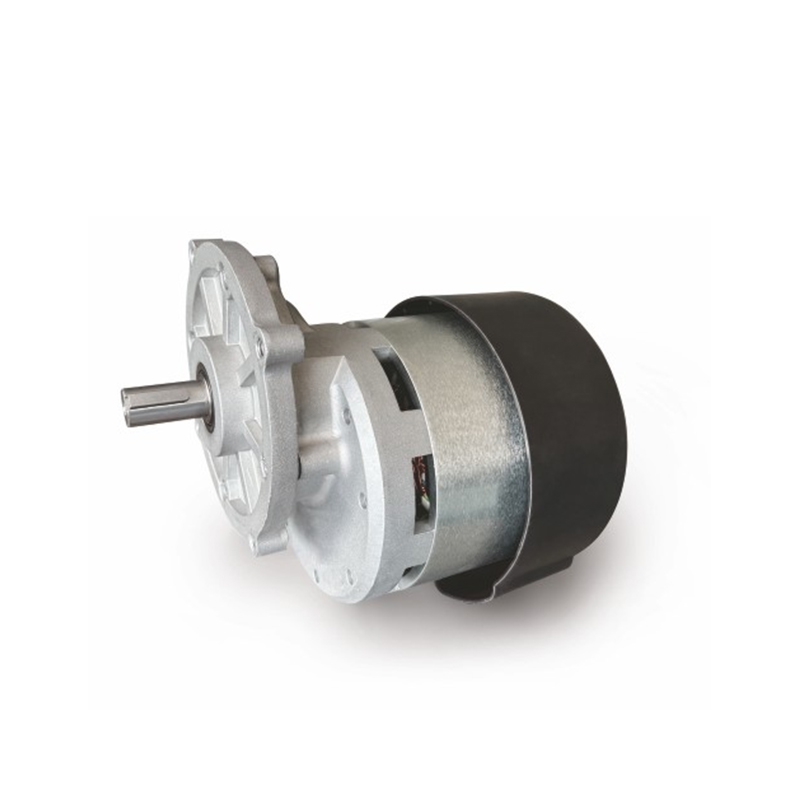
Worm gear motors use a helical worm shaft that meshes with a worm wheel at a 90-degree angle. This right-angle configuration makes them ideal for applications where a compact perpendicular drive is needed. Worm gear motors can achieve very high reduction ratios (up to 100:1 or more in a single stage) and are inherently self-locking in many configurations, meaning the output shaft cannot back-drive the motor. This self-locking property is valuable in applications like lifts, gates, and adjustable furniture. The trade-off is lower efficiency compared to spur or planetary types, particularly at high reduction ratios.
Helical Gear Motors
Helical gears have teeth cut at an angle to the gear axis, which causes multiple teeth to engage simultaneously during rotation. This produces smoother, quieter operation than spur gears and allows for higher load capacity. Helical DC geared motors are preferred in applications where noise reduction and smooth torque delivery are priorities, such as in HVAC systems, consumer appliances, and office automation equipment.
Key Specifications to Evaluate
Selecting the correct DC geared motor requires a clear understanding of the application's mechanical and electrical demands. The following specifications are the most critical to evaluate before making a selection:
- Rated Voltage: DC geared motors are typically available in standard voltages such as 6V, 12V, 24V, and 48V. The operating voltage must match the available power supply, as running a motor at incorrect voltage directly affects speed, torque, and lifespan.
- No-Load Speed (RPM): This is the rotational speed of the output shaft when no mechanical load is applied. Real operating speed under load will be lower and should be factored into design calculations.
- Stall Torque: The maximum torque the motor can produce before it stops rotating. Operating consistently near stall torque dramatically reduces motor life and generates excessive heat.
- Gear Reduction Ratio: Determines the relationship between motor shaft speed and output shaft speed. Higher ratios deliver more torque but lower output speed.
- Output Shaft Diameter and Type: The shaft must be mechanically compatible with the driven component — whether a wheel, lead screw, coupling, or pulley.
- Continuous Current Draw: Determines the power supply and wiring requirements. Exceeding rated current leads to overheating and premature failure.
- Efficiency: Overall efficiency accounts for both motor and gearbox losses. Higher efficiency means less wasted energy as heat, which is critical in battery-powered or thermally constrained systems.
DC Geared Motor Types Compared
The table below summarizes the practical differences between the four main gearbox types used in DC geared motors:
| Type | Efficiency | Noise Level | Torque Density | Best Use Case |
| Spur | High | Medium–High | Medium | General-purpose drives |
| Planetary | High | Low–Medium | Very High | Robotics, precision automation |
| Worm | Low–Medium | Low | High | Lifts, gates, self-locking apps |
| Helical | High | Low | High | Appliances, quiet environments |
Brushed vs. Brushless DC Geared Motors
DC geared motors are available in both brushed and brushless configurations, and the choice between them has significant implications for performance, maintenance, and cost.
Brushed DC motors use carbon brushes in contact with a rotating commutator to deliver current to the motor windings. They are simple, inexpensive, and easy to control — a straightforward voltage adjustment changes speed, and reversing polarity reverses direction. However, the brushes wear over time, generating dust and requiring periodic replacement. Typical brush life ranges from 1,000 to 3,000 operating hours depending on load and environment.
Brushless DC (BLDC) motors eliminate mechanical commutation by using electronic controllers to switch current through the windings. This removes the primary wear component, extending motor lifespan to tens of thousands of hours. BLDC geared motors also run cooler, more efficiently, and with less electrical noise. The trade-off is higher cost — both for the motor itself and for the electronic speed controller (ESC) required to drive it. For high-duty-cycle applications, the extended service life of a brushless unit typically justifies the premium.
Typical Applications of DC Geared Motors
The combination of controllable speed, high torque output, and compact form factor makes DC geared motors one of the most versatile drive components available. They are used across an enormous range of industries and products:
- Robotics and Automation: Joint actuators, gripper drives, mobile robot wheel drives, and conveyor systems all rely on DC geared motors for precise, repeatable motion control.
- Medical Devices: Infusion pumps, surgical tools, hospital bed adjustment systems, and rehabilitation equipment require quiet, reliable, and precise motion — areas where DC geared motors excel.
- Automotive: Power windows, seat adjusters, sunroof actuators, and mirror positioning systems use compact DC geared motors designed for long life and low noise.
- Smart Home and Access Control: Automatic door openers, smart locks, motorized blinds, and gate operators all use DC geared motors, often paired with position sensors or encoders for feedback control.
- Consumer Electronics: Printers, scanners, cameras with motorized zoom, and small home appliances use compact spur or planetary geared motors for cost-effective motion control.
How to Select the Right DC Geared Motor
A systematic selection process helps avoid both undersizing (which leads to overheating and failure) and oversizing (which wastes space, energy, and budget). Follow these steps to arrive at the right specification:
- Define the load torque: Calculate the torque required to move the load at the desired speed, including friction, inertia, and any intermittent peak loads. Apply a safety factor of at least 1.5x to your continuous torque requirement.
- Determine the required output speed: Identify the RPM range needed at the output shaft. This, combined with the torque requirement, will define the power requirement and guide gear ratio selection.
- Match voltage to your power supply: Confirm the available supply voltage and select a motor rated for that voltage to ensure correct operating speed and current draw.
- Choose the appropriate gearbox type: Consider space constraints, required noise level, efficiency needs, and whether back-driving prevention is necessary.
- Consider duty cycle: A motor running continuously at high load needs higher thermal ratings and potentially brushless construction. Intermittent or low-duty-cycle applications can often be served effectively by brushed motors at lower cost.
- Verify mechanical interface: Confirm shaft diameter, mounting hole pattern, and overall dimensions fit within the mechanical design of the product or system.
Extending the Service Life of a DC Geared Motor
Even a well-selected DC geared motor will fail prematurely if not properly installed and maintained. Several practical measures can significantly extend service life in real-world operating conditions.
Thermal management is one of the most important factors. Operating a motor continuously near its stall torque generates substantial heat, which degrades winding insulation and lubricant viscosity in the gearbox. Providing adequate ventilation, limiting operating time at peak load, or selecting a motor with a higher power rating than strictly necessary all help manage heat buildup effectively.
Lubrication within the gearbox is critical to minimizing wear between gear teeth and bearings. Most sealed geared motors are factory-lubricated for life, but in heavy-duty or high-temperature environments, specifying a motor with re-lubricable ports or selecting a unit pre-filled with high-temperature grease can extend the gearbox lifespan considerably. Additionally, avoiding radial or axial shaft loads that exceed the manufacturer's rated limits prevents premature bearing failure — a common cause of gearbox degradation in poorly designed mechanical assemblies.

-
Feedback
Related products

Hotline:0086-15869193920
Time:0:00 - 24:00
