

 English
 Deutsch
 italiano
 中文简体
中文简体
Author: Admin Date: 2026-03-17
DC Linear Actuators: How They Work, Key Specs, and How to Choose the Right One
Content
- 1 How DC Linear Actuators Work
- 2 Key Technical Specifications Explained
- 3 Lead Screw vs. Ball Screw: Choosing the Right Drive Mechanism
- 4 Feedback and Position Control Options
- 5 Environmental Ratings and Material Selection for Harsh Conditions
- 6 Common Applications of DC Linear Actuators
- 7 Practical Checklist for Selecting a DC Linear Actuator
DC linear actuators are among the most practical and widely deployed motion control components in modern engineering. From adjustable hospital beds and agricultural equipment to solar panel tracking systems and industrial automation, these compact devices convert the rotational output of a DC motor into precise, controlled linear motion — pushing and pulling loads along a straight axis with forces that can range from a few newtons to several thousand. Despite their prevalence, many engineers, system integrators, and product designers approach DC linear actuator selection without a clear understanding of the technical parameters that actually determine whether a given actuator will perform reliably in their specific application. This article addresses that gap directly, covering how DC linear actuators work, which specifications matter most, and how to match the right actuator to the demands of your system.
How DC Linear Actuators Work
The operating principle of a DC linear actuator is straightforward. A DC motor — typically a brushed or brushless motor running on 12V, 24V, or 48V DC — drives a worm gear or spur gear reduction stage that converts the motor's high-speed, low-torque rotation into lower-speed, higher-torque output. This geared output then rotates a lead screw or ball screw, which is threaded through a nut fixed to the actuator's inner tube or rod. As the screw rotates, the nut translates along its length, pushing or pulling the extending rod in and out of the actuator body. The result is linear motion with a stroke length determined by the screw's usable thread length.
Reversing the polarity of the DC voltage supplied to the motor reverses the direction of rotation and therefore the direction of travel of the rod — extending or retracting it on command. This simple directional control using voltage polarity is one of the key practical advantages of DC linear actuators over pneumatic or hydraulic alternatives, which require more complex valve and fluid management infrastructure to achieve bidirectional motion. Most DC linear actuators also incorporate built-in limit switches at both ends of travel that automatically cut power to the motor when the rod reaches full extension or full retraction, preventing mechanical overtravel and motor burnout.
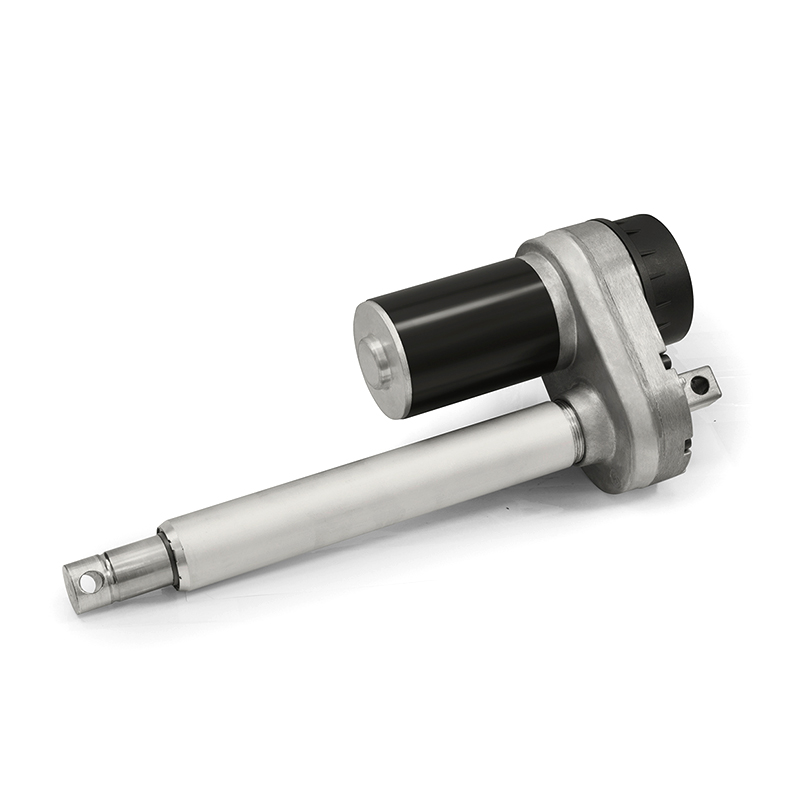
Brushed vs. Brushless DC Motor Actuators
The motor type inside a DC linear actuator has meaningful implications for performance and longevity. Brushed DC motor actuators are the most common and cost-effective option. They use carbon brushes to transfer electrical current to the rotating commutator, which creates friction and wear over time. Brushed actuators typically offer operational lifespans of 5,000 to 20,000 cycles depending on load and duty cycle conditions — sufficient for most commercial and light industrial applications. Brushless DC actuators eliminate brush wear entirely by using electronic commutation, extending service life significantly and reducing maintenance requirements. They are preferred in high-cycle industrial applications, medical equipment, and precision systems where reliability over tens of thousands of cycles is non-negotiable, though they carry a higher unit cost.
Key Technical Specifications Explained
Selecting the wrong DC linear actuator almost always comes down to misunderstanding or underestimating one or more of the core specifications. The following parameters define actuator capability and must be matched to your application's requirements before any purchasing decision is made.
| Specification | Typical Range | What It Determines |
| Stroke Length | 10 mm – 1,000+ mm | Maximum travel distance of the rod |
| Force (Load Capacity) | 10 N – 15,000+ N | Maximum push/pull force at rated speed |
| Speed | 1 mm/s – 100+ mm/s | Rod travel speed at rated load |
| Voltage | 6V, 12V, 24V, 48V DC | Power supply compatibility |
| Duty Cycle | 10% – 100% | Continuous vs. intermittent operation capability |
| IP Rating | IP42 – IP69K | Resistance to dust and water ingress |
| Self-Locking | Yes / No (worm vs. ball screw) | Whether position is held without power |
| Feedback Options | None, potentiometer, encoder, Hall sensor | Position sensing and closed-loop control |
Understanding the Force-Speed Tradeoff
One of the most important and frequently misunderstood relationships in DC linear actuator selection is between force and speed. For a given motor power, higher gear reduction produces more force but slower speed — and vice versa. Manufacturers typically publish force ratings at a specific speed under rated voltage. If your application requires both high force and fast speed simultaneously, you will need a larger motor and a more powerful actuator than the force rating alone might suggest. Always verify the force-speed curve for any actuator you are evaluating, not just the peak force figure, to ensure the actuator can deliver the required force at the speed your application demands.
Lead Screw vs. Ball Screw: Choosing the Right Drive Mechanism
The internal drive mechanism — lead screw or ball screw — has a substantial impact on actuator performance, efficiency, and suitability for different duty cycles and load conditions. Most standard DC linear actuators use a lead screw drive with an acme or trapezoidal thread profile. Lead screws are robust, cost-effective, and inherently self-locking due to the high friction between the screw and nut, meaning the actuator holds its position mechanically when power is removed without requiring a brake. This makes lead screw actuators ideal for applications like adjustable furniture, valve control, and positioning systems that need to maintain a set position under load without continuous power.
Ball screw DC linear actuators use recirculating steel balls between the screw and nut to reduce friction dramatically, achieving mechanical efficiencies of 90% or higher compared to 25–50% for typical lead screws. This efficiency advantage translates to faster speeds, lower current draw for a given force, and less heat generation during operation — all of which extend motor and drive component life in high-cycle applications. The tradeoff is that ball screws are not self-locking; an external brake or holding mechanism must be provided if the actuator needs to maintain position under load without power. Ball screw actuators are the preferred choice in precision automation, robotics, and medical equipment where efficiency, speed, and positioning accuracy outweigh the need for mechanical self-locking.
Feedback and Position Control Options
Basic DC linear actuators with only end-of-travel limit switches are adequate for simple open-close or extend-retract applications where intermediate positioning is not required. But many real-world applications need the actuator to stop at specific positions within its stroke — and for that, position feedback is essential.
- Potentiometer feedback: A linear or rotary potentiometer mechanically coupled to the actuator's drive mechanism produces an analog voltage signal proportional to rod position. This is the most common and cost-effective feedback solution, offering position resolution typically in the range of 0.1 to 1 mm depending on the potentiometer and control electronics used. Potentiometer-equipped actuators are widely used in agricultural machinery, marine applications, and industrial positioning systems.
- Hall effect sensor / magnetic encoder: Hall sensors detect the rotation of a magnet attached to the motor shaft, producing a pulse output that a controller counts to calculate position. These are more durable than potentiometers in high-vibration or harsh environments because they have no mechanical contact wear. Resolution depends on the number of pulses per revolution and gear ratio, but sub-millimeter resolution is achievable in well-designed systems.
- Optical encoder: Optical encoders offer the highest position resolution and are used in precision applications such as laboratory automation and medical devices. They generate quadrature pulse outputs that allow both position and direction detection, and can achieve resolutions of 0.01 mm or finer in high-resolution configurations. They are more sensitive to contamination than magnetic sensors and require cleaner operating environments.
- CANbus and serial communication: High-end DC linear actuators for industrial automation increasingly include integrated motion controllers with digital communication interfaces such as CANopen, Modbus RTU, or RS-485. These allow the actuator to receive position commands and report status directly over a fieldbus network, simplifying wiring and enabling integration into PLC-controlled systems without separate external motion controllers.
Environmental Ratings and Material Selection for Harsh Conditions
DC linear actuators are deployed across an enormous range of environments — from climate-controlled cleanrooms to outdoor agricultural and marine installations exposed to rain, dust, salt spray, and extreme temperatures. Selecting an actuator with appropriate environmental protection for your specific conditions is as important as matching its force and stroke to the application's mechanical demands.
The IP (Ingress Protection) rating system defines resistance to solid particle and liquid ingress using a two-digit code. IP54 actuators (dust partial protection, splash water resistant) are adequate for most indoor industrial environments. IP65 (dust tight, low-pressure water jet resistant) covers most outdoor applications in temperate climates. For wash-down environments, subsea equipment, or applications in continuous exposure to high-pressure water or submersion, IP67 or IP69K ratings are required. Beyond IP rating, the housing material matters significantly — aluminum alloy bodies offer good corrosion resistance at moderate cost, while stainless steel housings and rods are specified for marine, food processing, and chemical exposure environments where aluminum would corrode unacceptably.
Temperature Range Considerations
Standard DC linear actuators operate reliably between -10°C and +60°C. Applications outside this range — such as outdoor solar tracking systems in cold climates, automotive under-hood positioning, or industrial furnace-adjacent equipment — require actuators with low-temperature lubricants, high-temperature motor windings, and seals rated for the expected temperature extremes. Always verify the manufacturer's stated operating temperature range against your application's worst-case conditions, including the temperature inside any enclosure where the actuator will be mounted, which may be significantly higher than ambient due to heat generated by nearby components.
Common Applications of DC Linear Actuators
DC linear actuators are found across a remarkably broad spectrum of industries and product categories, often replacing manual adjustment mechanisms, pneumatic cylinders, or hydraulic rams where a self-contained, electrically controlled motion solution is more practical.
- Medical and healthcare equipment: Adjustable hospital beds, patient lift chairs, dental chairs, surgical tables, and rehabilitation equipment all rely heavily on DC linear actuators for quiet, precise, electrically safe positioning under patient loads. Medical-grade actuators comply with IEC 60601-1 standards and use low-voltage DC supplies to minimize electrical hazard risk.
- Agricultural machinery: Seed drill depth control, sprayer boom folding, hitch positioning, and cab seat adjustment are common agricultural actuator applications. These environments demand high IP ratings, wide temperature tolerance, and robust resistance to vibration and shock loads.
- Solar tracking systems: Single-axis and dual-axis solar panel trackers use DC linear actuators to rotate panel arrays to follow the sun's position throughout the day, improving energy yield by 25–40% compared to fixed installations. These actuators must operate reliably through thousands of daily cycles over 20-year system lifespans in fully outdoor environments.
- Industrial automation and robotics: Clamping fixtures, valve actuation, conveyor diverters, press platens, and robotic end-effector tools all utilize DC linear actuators for their compact form factor, precise control, and ability to integrate with PLC and motion controller systems without pneumatic infrastructure.
- Furniture and ergonomic products: Height-adjustable desks, reclining furniture, TV lift mechanisms, and adjustable monitor arms represent one of the largest and fastest-growing market segments for DC linear actuators, driven by demand for ergonomic home and office products with quiet, smooth electric adjustment.
Practical Checklist for Selecting a DC Linear Actuator
Pulling together the key selection criteria into a structured evaluation process prevents the most common mistakes in actuator specification. Before contacting a supplier or placing an order, confirm the following for your application:
- Required stroke length: Measure the exact travel distance needed between fully retracted and fully extended positions, including any mechanical clearance margins at each end of travel.
- Load force with safety factor: Calculate the maximum force the actuator must produce — including dynamic loads, shock loads, and any side loading — then apply a safety factor of at least 1.5 to 2 times the calculated value when selecting rated force capacity.
- Required speed: Determine the maximum acceptable cycle time and calculate the minimum rod speed needed to complete the stroke within that time. Cross-reference against the manufacturer's force-speed curve to confirm the actuator can deliver the required force at that speed.
- Duty cycle: Estimate what percentage of total operating time the actuator will be in motion. Continuous-duty applications require actuators rated for 100% duty cycle; intermittent applications can use lower-rated units at lower cost, but the actuator must be allowed adequate rest time between cycles to prevent thermal damage.
- Mounting configuration: Confirm the mounting bracket style, pin diameter, and attachment point geometry required for both the actuator body and rod end, ensuring compatibility with your mechanical design before ordering.
- Environmental conditions: Define the IP rating, temperature range, and corrosion resistance required for the installation environment, and verify that the selected actuator meets or exceeds all of these requirements simultaneously.
DC linear actuators reward careful specification with years of reliable, low-maintenance service. Approaching selection with a clear understanding of the technical parameters that govern their performance — rather than defaulting to the most familiar brand or lowest price — is the single most effective step any engineer or designer can take toward a successful, durable motion control solution.

-
Feedback
Related products

Hotline:0086-15869193920
Time:0:00 - 24:00
